The Honest Answer Upfront
If you search for "forestry mulching vs bulldozing" you'll find a lot of content written by forestry mulching companies that makes bulldozing sound like a reckless, destructive method that no sensible person would choose. That's not accurate and it's not helpful to you.
Both methods have legitimate uses. Bulldozing is the right tool for certain jobs. Forestry mulching is the right tool for most of the residential, agricultural, and light commercial jobs we see in Central Ohio. The answer to which you should choose depends entirely on what you're doing with the land after clearing.
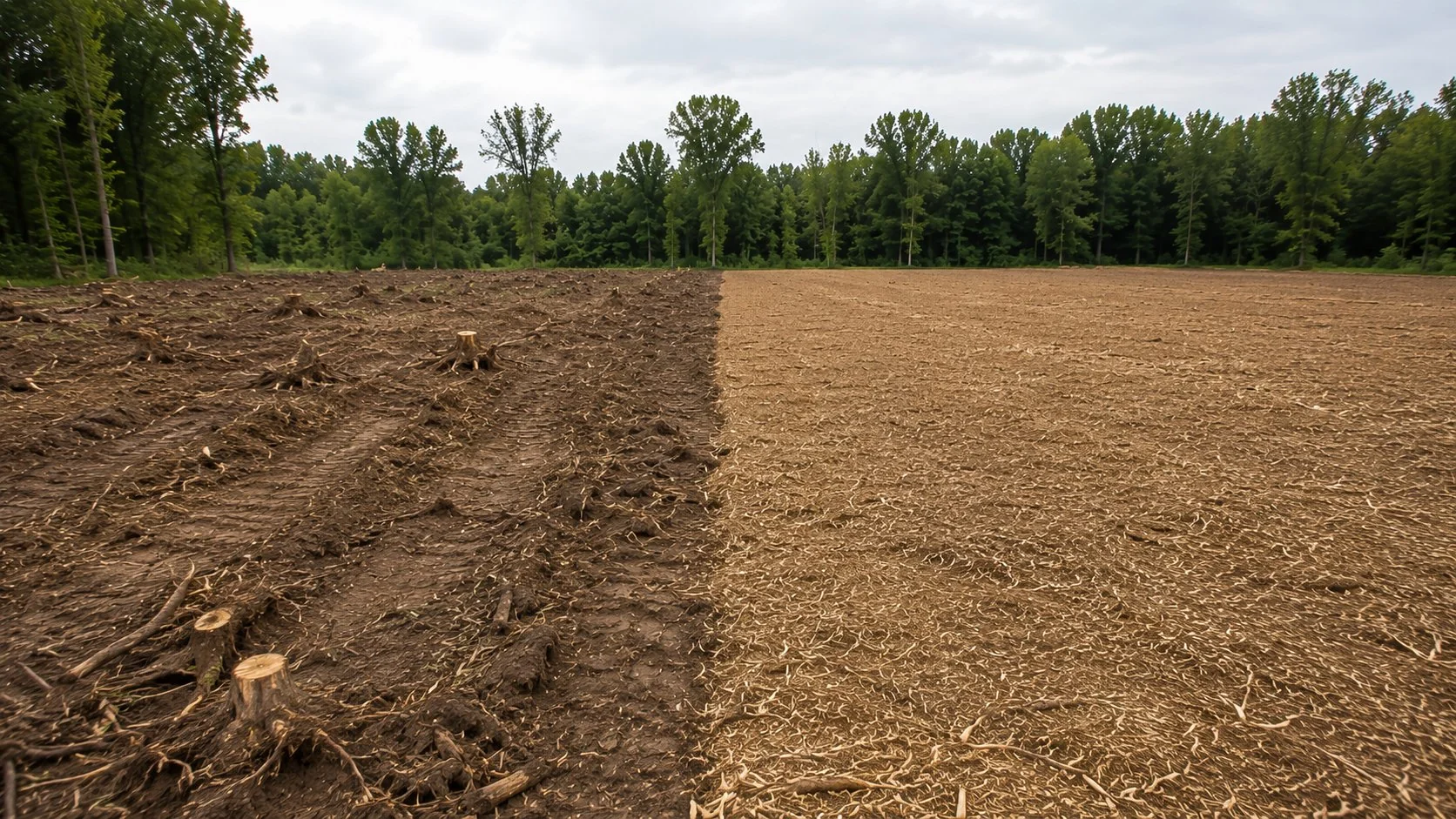
What Bulldozing Does
A bulldozer pushes trees and brush over, uprooting root systems and piling the material as it goes. The result is bare mineral soil — the topsoil layer is typically mixed into the debris piles or displaced. Stumps and root balls are pushed into piles. Those piles need to be either burned or hauled away.
Bulldozing is fast on large trees. It's the right method when you need root systems removed — when you're putting in a parking lot, a foundation, or any hardscape where roots below grade are a liability. It's also efficient when you have very large trees that exceed what a mulcher can handle and you're not concerned about preserving the soil surface.
What Forestry Mulching Does
A tracked forestry mulcher grinds trees, brush, and vegetation in place using a high-speed rotating cutting head. Everything — stems, branches, bark, leaves — is processed into a wood chip mulch layer that stays on site. The root systems remain in the ground and decompose over time. Soil structure is not disturbed.
The mulch layer left on the surface is functional, not just incidental. It suppresses weed regrowth, prevents erosion, retains soil moisture, and breaks down over 12 to 24 months into organic matter that improves soil health. It's a legitimate benefit, not just a byproduct.
Side-by-Side Comparison
Forestry Mulching vs. Bulldozing
When to Choose Forestry Mulching
- Residential lot clearing where you'll be seeding grass, not pouring concrete
- Pasture reclamation — you want productive soil, not bare dirt
- Invasive species removal — large-scale honeysuckle and multiflora rose clearing
- Fence line clearing — work around existing infrastructure
- Properties on slopes where dozer work creates erosion problems
- Any job where debris hauling or burning is inconvenient or costly
- Properties in Central Ohio's clay-heavy soil zones where dozer compaction is a concern
- Sensitive sites where soil disturbance needs to be minimized
When to Choose Bulldozing
- Site preparation for foundations, parking lots, or hardscape where roots below grade are a problem
- Large trees over 12–15 inches diameter that exceed mulcher capacity
- Projects where the site will be completely regraded anyway
- Mass grading operations where vegetation removal is just the first step in major earthwork
"When someone calls us and says they're building a commercial building with a parking lot, we tell them honestly that a dozer or excavator is probably the right first step for the building footprint — you want those roots out. But for the perimeter clearing, the landscaped areas, the areas that will become grass or managed vegetation — that's mulcher work. The two methods aren't always in competition. Sometimes you need both."
The Real All-In Cost Comparison
The per-acre clearing price is just one line on the total cost ledger. For a typical 3-acre residential lot in Central Ohio, here's how the all-in costs often compare:
Bulldozer approach: Clearing pass $3,000–$6,000 + debris burning or hauling $1,000–$3,000 + stump grinding $1,500–$3,000 + erosion control seeding $600–$1,200 = $6,100–$13,200 total
Forestry mulching approach: Clearing pass $4,500–$10,000, all-in. Mulch stays on site. No secondary costs. = $4,500–$10,000 total
The ranges overlap and there are scenarios where dozer clearing comes out cheaper. But for most residential and agricultural jobs in Central Ohio, the all-in comparison favors mulching.
Frequently Asked Questions
Can roots from forestry mulching cause problems later?
Root systems left in place after mulching decompose over time — typically 3 to 7 years depending on species. For lawns, pastures, and agricultural use, this is not a problem. For hardscape or foundations, roots below grade are a concern and dozer or excavator work is more appropriate.
Does the mulch layer attract termites or pests?
The wood chip mulch from forestry mulching is not meaningfully different from landscaping mulch in terms of pest attraction. It breaks down relatively quickly in Ohio's climate. Keeping the mulch layer away from the immediate foundation of a structure is standard practice, just as with any landscaping mulch.
Can you combine both methods on the same property?
Yes. Some projects benefit from both — dozer work on the building footprint and access road, mulching on the surrounding cleared areas. We can help you think through what makes sense for your specific project.
Which is better for Ohio's clay soils?
Forestry mulching is significantly better for Ohio's clay-heavy soils. Bulldozing compacts and displaces clay soils, especially when wet, and the resulting surface can be difficult to establish vegetation on. Mulching leaves the soil profile intact and the mulch layer improves drainage and organic matter over time.